
Room guide · Living-room colours
Living Room Colours as per Vastu: Walls, Sofas and the Whole Room
A room name does not settle its palette. Connect wall paint and sofa fabric with the actual location, existing materials and a clearly explained Vastu interpretation.

Published · 7 min read
If you are choosing living-room colours according to Vastu, begin with the part of the home the room actually occupies. Then separate the decisions: wall paint, sofa fabric, curtains and the finishes you intend to retain.
My Foundation notes discuss light finishes for the north-east and earthy colours within south-west teaching. These are starting points within a named interpretation. A room label such as “living room” does not establish which palette applies to every surface.
Choose the palette for the actual room, with a clear reason for each important choice. That approach helps you move from a list of supposedly lucky colours to a coherent brief you can discuss with your family and designer.
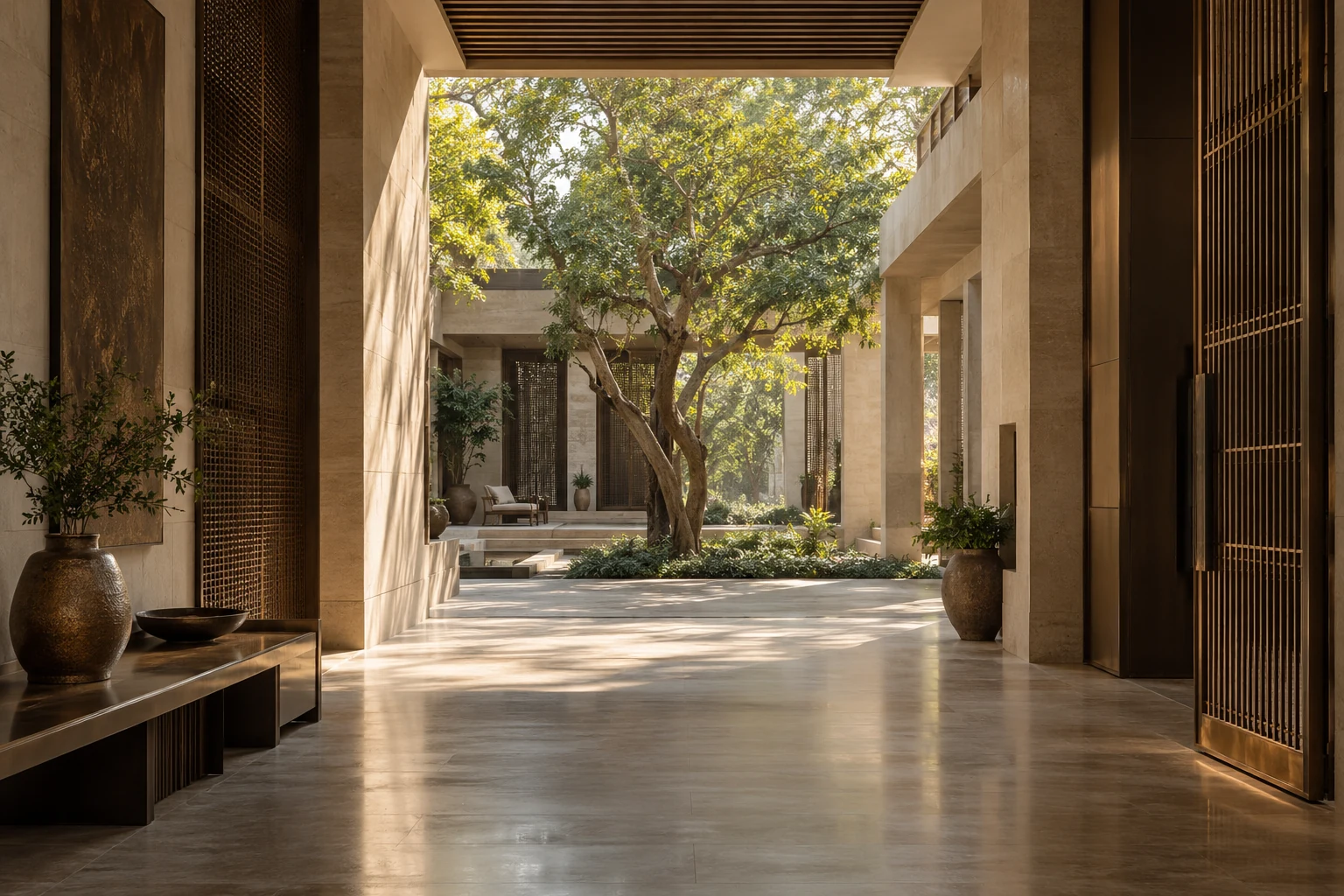
Locate the room before selecting a directional palette
A home's facing direction and the location of its living room answer different questions. An east-facing entrance does not place every room in the east. The direction a wall faces is also different from the sector in which that wall stands.
Use a current plan with the property boundary and orientation established. Identify the room's footprint, the seating arrangement and the surfaces under consideration. If a large living area spans several sectors, record that extent rather than assigning the whole space one convenient label.
The 16-zone guide explains the directional vocabulary. Where the boundary or orientation is uncertain, clarify it before asking for precise colour assignments.
What the Foundation colour guidance supports
Here are examples actually found in the reviewed course material. They are modern course interpretations, not a complete classical wall-paint chart or a promise of a particular life outcome.
| Context | Guidance in the notes | How to use it in a room review |
|---|---|---|
| North-east finishes | NE names off-white and very light cream. Session 9 includes white and light blue. | Compare suitable light finishes after establishing the actual location and room conditions. |
| South-west home design | Session 9 names brown, beige and terracotta in its earthy-colour guidance. | Discuss which surface or furnishing is being considered; the notes do not require every object to match. |
| North-west teaching | NW names mild white, sky blue and light grey; Session 9 also gives green and pink in its home-design section. | Ask which interpretive framework supports the proposed palette. These lists do not establish one unanimous rule. |
This variation is worth explaining. A symbolic colour, an elemental association and a recommendation for a physical finish can have different purposes. Even two home-design lists may differ. My current Foundation 2.0 method calls for the interpretive lens to be named alongside location, condition, actual use, evidence and the next step.
A recommendation should therefore say which teaching it uses, where it applies and why that change is proportionate. It should also explain what can remain as it is.
What is the classical passage describing?
Classical furniture texts do discuss colour. In Acharya's translation of Mānasāra, 44.21, matching colour appears in a description of couch components; 44.50 discusses painted and carved ornament. These are craft instructions in their own setting. The checked passages do not supply a direction-by-direction modern sofa-fabric chart.
A different chapter illustrates another distinction. Mānasāra 7.155–162 describes Brahmā's golden complexion and white clothing separately. Choosing a wall colour from either attribute is an additional interpretation. It should be explained as such, with the particular surface and purpose identified.
How to choose a sofa colour according to Vastu
A sofa is a substantial part of the room's colour composition, but its upholstery is only one aspect of the object. Its size, position, condition and effect on movement also belong in the review.
The Foundation material reviewed here does not establish a separate, universal sofa-colour formula. Use the room's documented interpretation to develop a shortlist, then compare actual fabric samples with the walls, floor, curtains and lighting.
For example, where an earthy palette is being considered, beige upholstery and a terracotta accent are possible design options to compare. That is an illustrative palette choice, not a requirement that every south-west sofa must be beige or that terracotta guarantees stability.
Before replacing a serviceable sofa, identify the finding that replacement would address. If the concern is obstructed movement or damaged furniture, recolouring alone does not resolve that condition. If the question is simply how to finish the room coherently, start with the samples and the elements you want to retain.
There is no verified percentage, fabric weight or compulsory shade code supplied by this source review. Ask for an explained recommendation rather than an unnecessarily precise number.
Compare the actual materials under the room's lighting
Put the paint and upholstery samples beside the retained flooring and woodwork. Review them under the lighting you expect to use, including the room's usual evening arrangement. Agree on the specific sample before relying on a broad label such as cream, grey or blue.
The CIE's public summary of Colorimetry includes illuminating and viewing conditions within colour assessment. Comparing samples in the room is a practical design application of that distinction; it does not validate a Vastu association.
Also record the condition of the surface. Dampness, damage, poor lighting and an obstructed opening are separate findings. The current MVDE sequence places those conditions before the selection of a remedy object or colour.
A useful palette brief preserves the important choices
Illustrative example · not a client case
A family is redecorating a living room described on a verified plan as mainly south-west. They want to retain the timber furniture and flooring, replace worn upholstery and repaint a wall that has a recurring damp patch.
The first step is to address the dampness with the appropriate professional. The palette discussion can then compare a beige upholstery sample and alternative wall finishes beside the retained materials. The course's earthy-colour association is explained as the interpretive basis being considered.
The family may retain more than they expected. They also gain a clear distinction between a physical repair, an aesthetic preference and a Vastu recommendation. Each decision has a stated purpose before money is committed.
Opens WhatsApp with a prepared message to +91 9873335596. Add your details, review the message and tap Send. This starts an enquiry; it does not book or pay for a consultation.
Common living-room colour questions
Is one colour suitable for every living room?
The reviewed material does not establish that. Location, actual use, existing finishes and the stated interpretation are needed to move from a general preference to a room-specific choice.
Does a dark sofa automatically create a Vastu defect?
A colour label alone does not establish a property diagnosis. Review its location and the whole arrangement before deciding whether any change is justified. The colour of one item does not establish the cause of a medical, financial or relationship difficulty.
Must the walls, sofa and curtains all be the same colour?
No such whole-room matching rule was established from the sources reviewed. Identify the surface and purpose of each recommendation instead of applying one shade indiscriminately.
What if the living room includes a home mandir?
Record the worship area and its daily use separately within the shared room. The pooja-room colour guide helps distinguish the room finish from the colours of devotional objects and ritual materials.
Review the room before committing to the palette
For an existing home, Property Vastu Diagnosis is the relevant starting point. Share your city, current plan, room photographs, the finishes you wish to retain and the decision you need help making.
For a home still being designed, Private Blueprint Review brings these choices into the wider planning discussion. We will clarify the suitable scope, required information and current fee before proceeding. The remedy-assessment guide explains how to evaluate the reason for a proposed change.
Opens WhatsApp with a prepared message to +91 9873335596. Add your details, review the message and tap Send. This starts an enquiry; it does not book or pay for a consultation.
Sources and scope
This guide uses Ashish Kapoor's The Scientific Vastu Foundation Course 2.0, revised 2 September 2026, and selected colour guidance in NE, NW and Session 9 Foundation. Returned readable text was reviewed; no recording or visual slide-page inspection is claimed.
The classical references use P. K. Acharya's Mānasāra translation at the identified passages. Its Sanskrit was not independently checked. The scope is furniture craftsmanship and deity description, not a verified universal interior-colour system.
The linked CIE page is a public publication summary, not a claim to have read the full technical report. The sample-selection steps, palette example and family scenario are original editorial applications. No colour is presented as a guaranteed remedy for personal outcomes.