
Foundation · Elements and interpretation
Five Elements in Vastu: Meaning, Interpretation and Your Home
Earth, water, fire, air and space offer an interpretive vocabulary. Learn how to connect that language to the conditions in your own home.

Published · 7 min read
If you have been told that an element in your home is “weak” or “out of balance,” the useful question is: what does that description refer to in this property? A wall, an opening, a water condition, an activity—or an interpretation that still needs explaining?
The five elements can provide a thoughtful vocabulary for discussing space. Their value in a Vastu review depends on how clearly that vocabulary connects to the home in front of us. This guide introduces the names, explains one example from my MVDE Foundation teaching, and shows how to ask for advice you can understand.
An element gives us a way to interpret a condition. The condition still has to be established.
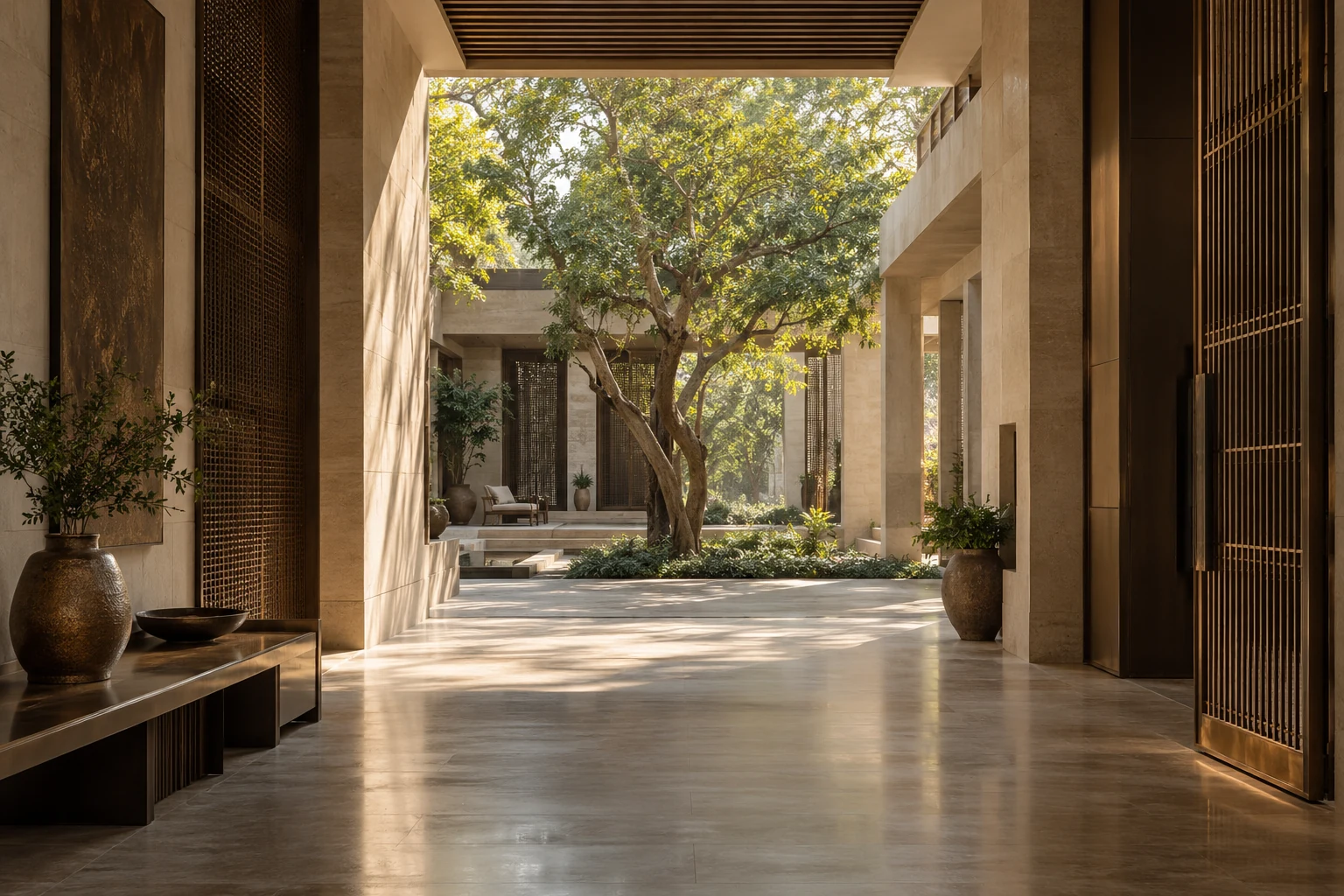
What are the five elements discussed in Vastu?
The familiar five-element vocabulary is earth, water, fire, air and space. The Sanskrit names below occur in the Taittirīya Upaniṣad, II.1, where the sequence forms part of a philosophical account of emergence from the Self.
| English name | Sanskrit name in the passage |
|---|---|
| Earth | Pṛthivī |
| Water | Āpaḥ |
| Fire | Agni |
| Air | Vāyu |
| Space | Ākāśa, rendered “ether” in the cited translation |
This is a classical philosophical reference for the vocabulary. That passage does not supply a house plan, a five-element directional chart or a list of domestic remedies. A modern Vastu application needs its own explanation. Read the passage in A. Mahadeva Sastri’s translation.
In MVDE Foundation, Tattvas appear after directions and zones. That teaching order matters: establish where something is, then examine the interpretive framework being applied to it. A coloured element chart becomes more useful when its assumptions are visible.
What should “elemental balance” explain?
The phrase should lead to a specific discussion. Which part of the property is being assessed? What is present there? Which quality is being considered? How does the proposed change respond to the finding?
Without those answers, “balance” can sound precise while leaving the homeowner unsure what to do. It does not follow that every room needs equal quantities of five materials, or that the same colour, object or arrangement belongs in every home.
A physical material and an interpretive quality are also different things. A stone object has a location, size and weight. Calling it an earth-related remedy introduces a further claim about its purpose. The recommendation should explain that step rather than relying on the name of the material.
The same discipline applies to a fountain or mirror. Before choosing one, understand the condition being addressed, the proposed placement and the practical implications. A visual resemblance to an element is not a complete assessment.
Earth in the MVDE Foundation example
My Foundation 2.0 notes introduce South-West and Earth through five qualities: mass, containment, stability, continuity and support. These are identified as qualities used in the course. The next question is whether the actual physical condition supports, conflicts with or complicates that reading.
A continuous boundary, a frequently used opening and an area affected by dampness present different conditions. Describing all three simply as “South-West” loses information needed for a useful discussion.
Here, the distinction between observation and interpretation remains explicit. “There is an opening in this wall” can be checked. “This arrangement complicates the course’s containment reading” identifies an interpretation. Neither statement establishes the cause of a family’s relationship, financial or medical difficulties.
The Foundation notes make the limit clear: an association is a lens, not proof of a life event. The purpose is to improve the questions we ask of a property.
Opens WhatsApp with a prepared message to +91 9873335596. Add your details, review the message and tap Send. This starts an enquiry; it does not book or pay for a consultation.
Two South-West areas, two different conversations
Illustrative example · not a client case or a promised result
Consider two homes with South-West areas located on verified plans. In Home A, the area contains an intact boundary and fixed storage used as intended. The family has heard that South-West needs “more earth” and is considering another heavy object.
The first question is what finding would justify that addition. The existing condition may already express the course’s qualities of mass and containment. A thoughtful review can identify something to retain. Adding weight merely to repeat a label has not yet been justified.
In Home B, a passage runs through the area and there is visible dampness near a wall. The owner is considering the same object. This time, the review needs to understand the passage, actual use and source of the dampness. Recording and addressing the physical condition comes before selecting an object.
These examples do not prescribe blocking a passage, sealing an opening or changing a load. They show why a shared directional association cannot settle different property decisions. Any building work requires the relevant professional judgment and an agreed scope.
A useful way to observe your own home
You can prepare a clearer account without attempting to diagnose an elemental imbalance. Walk through the home and write down what you can describe directly. These are practical observation prompts, not classical element assignments:
- Boundaries and fixed features. Note changes to walls, openings and storage since the latest plan.
- Water conditions. Record visible dampness, a leak or a water installation, including what has already been investigated.
- Light and openings. Describe where light enters and which openings are used, obstructed or absent from the drawing.
- Movement and use. Identify regular passages, temporary storage and rooms used differently from their labels.
- Uncertainty. Mark anything you cannot confirm, including orientation or the boundary covered by the plan.
Use descriptions such as “the door opens onto stored boxes” or “the drawing predates this partition.” They make the starting information easier to check than “the energy here is wrong.” An observation can be useful even before its Vastu significance is discussed.
What needs the wider property context?
A detailed reading needs a current plan, its orientation basis, the areas included in the assessment and their actual use. A flat, an independent house and a property still being designed raise different questions about boundaries and what can reasonably change.
The 16-zone guide explains the location vocabulary. For practical preparation, use the online flat review guide or the existing-house checklist. Those inputs help connect elemental language to a defined property rather than an isolated image.
A useful recommendation should identify its basis, explain any uncertainty and distinguish the assessment from detailed corrections. Sometimes the next step is a repair or clarification. Sometimes it is to preserve a suitable arrangement. A remedy becomes a considered choice when the reasoning is clear.
Questions homeowners often ask
Can a colour alone balance an element?
A colour choice needs a stated purpose and property context. The name of a colour alone does not establish that a condition has been assessed or corrected.
Does a five-element chart replace a Vastu review?
A chart may introduce an interpretive framework. A review also considers verified location, physical conditions, actual use and the evidence behind a proposed next step.
Do I need to buy remedies before asking for advice?
No. Begin with your question and the information available. Property Vastu Diagnosis covers the agreed assessment and findings; detailed correction and implementation are agreed separately.
Understand what the advice means for your home
If you have received conflicting element-based advice, Property Vastu Diagnosis can establish the assessment basis and explain the findings. Start with your city, property type and the decision you want reviewed. We will discuss the required information, suitable scope and fee.
For a home still on the drawing board, explore a Private Blueprint Review while the design choices remain open.
Opens WhatsApp with a prepared message to +91 9873335596. Add your details, review the message and tap Send. This starts an enquiry; it does not book or pay for a consultation.
Sources and interpretation
- The Scientific Vastu Foundation Course 2.0, teaching notes modified 2 September 2026: “The Zone Formula,” “Step 3 Preview—Tattva,” “South-West + Earth” and “Condition Before Object.” This source supports the course’s Earth example and the sequence of observation, interpretation and next step. The date identifies the document revision, not the lecture delivery date.
- Taittirīya Upaniṣad, II.1, first anuvāka: the selected elemental sequence checked in the Sanskrit text and A. Mahadeva Sastri’s 1903 translation, Book II, chapter VI, passage 3. Used for the five names and philosophical context only.
The worked example and observation prompts are original editorial applications. The detailed elemental example is the Foundation source’s Earth preview. Classical attribution and course interpretation do not establish scientific validation of personal outcomes.